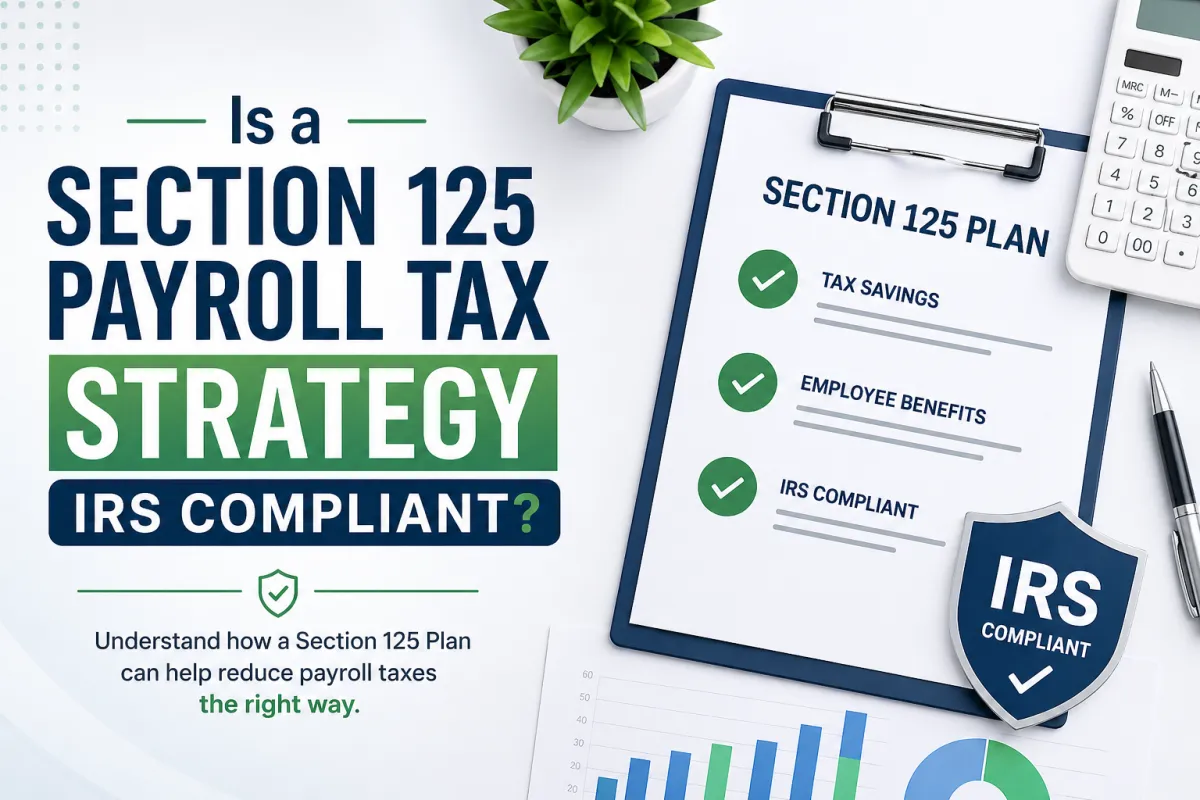
Is a Section 125 Payroll Tax Strategy IRS Compliant? What Every Employer Needs to Know
When an employer hears that a payroll tax reduction strategy can save hundreds of thousands of dollars annually without cutting benefits or changing health plans, the first, and entirely reasonable, question is: Is this actually legal?
It is a question every CFO, HR director, and business owner should ask before implementing any structure that touches payroll taxes. And when the strategy in question is built on a Section 125 payroll tax strategy, the answer is grounded not in opinion, but in established IRS statute.
A properly structured Section 125 cafeteria plan, paired with a Section 105 Self-Insured Medical Expense Reimbursement Plan (SIMERP), is not a gray-area workaround. It is an employer benefit mechanism explicitly authorized under the Internal Revenue Code, supported by ERISA compliance, ACA alignment, and HIPAA-aware administration. The employer payroll tax savings overview provides full context on how the program is positioned, and this blog explains the compliance architecture in plain language so decision-makers can evaluate it with confidence.
The Problem: Employers Confuse Legal Tax Strategies With Aggressive Ones
There is a real and important distinction between a compliant employer benefit strategy and an aggressive tax position, but that distinction often gets lost in the noise.
Many employers who could legally reduce their FICA obligations never do so, not because the strategy is unavailable to them, but because they associate any payroll tax reduction program with risk. They have seen headlines about abusive tax shelters, IRS enforcement actions, and penalties tied to overly aggressive structures. Understandably, that creates hesitation.
The problem is that hesitation has a cost. Every payroll cycle processed without an optimized structure is a cycle where legal, IRS-authorized savings are left on the table. For a business with 300 W-2 employees, that can represent $192,000 or more in annual FICA exposure that could have been reduced through a fully compliant plan.
The distinction that matters is not whether a strategy reduces taxes; it is how it does so and whether that method is grounded in statute, documented correctly, and administered by qualified professionals. The full Section 125 compliance framework addresses exactly this, covering the legal foundation employers need to review before moving forward.
The IRS Code Sections That Make This Strategy Legal
A compliant Section 125 payroll tax strategy draws on three established IRS code sections working in combination. Understanding each one removes the ambiguity that causes hesitation.
IRS Code Section 125 — The Cafeteria Plan Foundation
Section 125 of the Internal Revenue Code authorizes employers to offer cafeteria plans, benefit structures that allow employees to elect certain qualified benefits on a pre-tax basis. When an employee makes a pre-tax election through a Section 125 plan, the elected amount is excluded from the employee's taxable wages for both income tax and FICA purposes.
This is the mechanism that reduces taxable payroll. Because the election is pre-tax, the wage base subject to employer FICA is lower, and that reduction is entirely authorized under IRC §3121(a)(5)(G) and §3306(b)(5)(G), which explicitly excludes qualified cafeteria plan elections from FICA taxable wages.
This is not a loophole. It is the intended operation of a decades-old employer benefit statute.
IRS Code Section 105 — The Reimbursement Plan Structure
Section 105 authorizes employer-funded self-insured medical expense reimbursement plans. Under this structure, employers fund reimbursements for employees' qualified medical expenses, and those reimbursements are excludable from the employee's gross income when the plan is administered correctly.
The SIMERP, Self-Insured Medical Expense Reimbursement Plan, operates under Section 105. It is the benefit delivery mechanism that sits within the Section 125 cafeteria plan structure. Together, §125 and §105 create both the pre-tax election framework and the compliant reimbursement infrastructure.
IRC Section 213(d) — Qualified Medical Expense Classification
Section 213(d) defines what qualifies as a medical expense eligible for tax-advantaged treatment. Reimbursements made through the SIMERP must correspond to qualified medical expenses under §213(d), which is why formal plan documentation, actuarial records, and TPA administration are essential components of the structure, not optional add-ons.
The interaction of these three code sections, §125, §105, and §213(d), is what distinguishes a fully compliant employer payroll tax reduction plan from an improvised or undocumented tax position. Employers who want to review how each section applies in practice can explore the full Section 125 compliance framework for a detailed breakdown.
Missed Opportunity: Most Employers Have Never Had This Properly Explained
The compliance architecture of a Section 125 strategy is well established. But the majority of employers with 100 or more W-2 employees have never had a structured conversation about it in the context of payroll tax reduction.
Brokers focus on plan design and carrier relationships. CPAs focus on income tax planning. Payroll providers process what they are given. None of these advisors, by default, is positioned to identify the FICA reduction opportunity that a properly structured Section 125 cafeteria plan can create.
The result is that large, legitimate tax savings, savings grounded in federal statute, backed by ERISA review, and audited by the IRS without enforcement action, go unclaimed year after year. Employers across healthcare, manufacturing, automotive, and education, for example, are often the strongest candidates for this structure, as detailed in how the program applies across industries.
The missed opportunity is not a matter of complexity. It is a matter of introduction. Once employers understand the structure clearly, the compliance review process tends to move quickly.
How Payroll Tax Optimization Delivers a Compliant Structure
The program offered through Payroll Tax Optimization is built on the §105 and §125 framework described above, with several layers of compliance infrastructure that employers review as part of their due diligence process.
Formal Plan Documentation. Every implementation begins with a formal plan document established under IRS §105 and §125. This is not a generic template; it is a structured employer benefit plan that specifies election mechanics, qualified expense classifications, participation rules, and administrative procedures. This documentation is the first line of defense if the plan is ever subject to scrutiny.
SOC 2 Type II Certified Third-Party Administration. The TPA managing claims processing, payroll coordination, employee elections, and recordkeeping holds SOC 2 Type II certification, the security and operational standard that employers and their advisors expect before trusting a program with payroll and health data.
ERISA Alignment. The plan is structured within an ERISA-aware framework. This means formal plan materials, summary documentation, employee disclosures, and administrative records are maintained in a way that satisfies ERISA's requirements for employer-sponsored benefit plans.
ACA Compliance. Participation in the program requires employees to have qualifying health coverage, which preserves ACA alignment. The employee health plan qualifies as Minimum Essential Coverage under the ACA and is designed to fit within the participatory wellness model described in Federal Register Vol. 78, dated June 3, 2013.
HIPAA-Aware Data Handling. Protected health information collected through plan administration is handled under HIPAA-aware processes. Employers do not need to build a separate data governance infrastructure; the TPA manages it as part of the program.
Audit Protection. The TPA managing this program has passed multiple IRS and DOL audits with zero enforcement actions. Enrolled employers receive audit-response support, including plan documents, actuarial certification, payroll records, and employee elections, so no employer is left building a response from scratch if questions arise.
Employers who want to validate this infrastructure before committing to any implementation can review the employer FAQ library on SIMERP and Section 125, which covers audit history, ACA alignment, ERISA documentation, and TPA credentials in detail.
Who May Qualify for This Compliant Structure
The Section 125 payroll tax strategy may be a strong fit for employers who meet the following general criteria, though final eligibility depends on specific workforce and payroll factors:
100 or more W-2 employees — this is the general threshold where the economics are most meaningful to model
Existing qualifying health coverage — employees participating in the plan must have compliant major medical coverage in place, which supports ACA requirements
W-2 payroll structure — the pre-tax election mechanics are tied to W-2 employment, not 1099 contractor arrangements
Stable workforce composition — industries with consistent hourly or support-staff populations tend to see the strongest participation and savings profiles
Leadership focused on compliance first — employers who want audit-ready documentation, not just a savings promise, are the right fit for this structure
Industries that frequently benefit include healthcare organizations, automotive dealer groups, school districts, logistics companies, and manufacturers, all of which carry large W-2 populations that make the FICA reduction opportunity meaningful in dollar terms.
Key Benefits of a Properly Structured Section 125 Plan
For employers who qualify and implement the structure correctly, the following outcomes may apply:
Significant FICA reduction. Employers may save approximately $640–$1,120 per W-2 employee annually in payroll taxes, depending on workforce size and plan participation rates.
Improved employee take-home pay. Employees who participate in the pre-tax election may see approximately $150 more per pay period, without any change to base compensation or existing benefits.
No disruption to current health coverage. Existing carriers, brokers, and plan designs remain in place. The Section 125 structure supplements current benefits rather than replacing them.
Self-funding implementation. The FICA savings generated by the program typically cover the cost of implementation, meaning there is no net upfront employer investment.
Full documentation and audit readiness. Plan documents, elections, actuarial records, and compliance support are maintained from day one, not assembled retroactively if questions arise.
Common Mistakes Employers Make When Evaluating Compliance
Assuming all payroll tax reduction programs are the same. They are not. The legal defensibility of a Section 125 strategy depends entirely on how it is documented, administered, and maintained. Employers should evaluate the specific code sections, plan documents, TPA credentials, and audit history of any program before enrolling.
Confusing compliance hesitation with compliance risk. Being cautious before implementing a new benefit structure is appropriate. But caution should lead to due diligence, reviewing legal foundations, auditor records, and TPA credentials, not to indefinite inaction.
Implementing without formal plan documentation. A Section 125 strategy that lacks formal plan documents, election records, and actuarial support is not compliant; it is a tax exposure. Documentation is not optional in this structure. It is the structure.
Choosing a TPA based on savings projections alone. Employers should verify SOC 2 Type II certification, HIPAA compliance, ERISA awareness, and audit history before selecting a TPA. The savings are only as secure as the administration behind them.
Delaying review until a more convenient time. FICA savings are calculated per payroll cycle. Every quarter spent evaluating rather than implementing is a quarter where compliant, authorized savings are uncaptured. Additional guidance on structuring a review timeline is available through the Section 125 employer guides and resources.
Conclusion
A Section 125 payroll tax strategy is IRS-compliant when it is built correctly. That means formal plan documentation under §105 and §125, qualified medical expense classification under §213(d), ERISA-aligned administration, ACA and HIPAA awareness, and a certified TPA with an established audit record.
The compliance question is not whether this type of structure is legal. It is whether the specific program an employer is evaluating has been built to the standard that makes it defensible. That distinction is what separates a sound employer benefit strategy from a tax position that creates more risk than it resolves.
For employers with 100 or more W-2 employees who want to understand whether this structure may be a fit, and what the potential FICA savings could look like for their specific workforce, the live calculator at Payroll Tax Optimization allows employers to model their numbers before committing to anything.
Ready to Review a Compliant Section 125 Strategy for Your Business?
Get your free savings estimate today. Use the live savings calculator at Payroll Tax Optimization to model your potential annual FICA reduction, then request your free savings report to see the full compliance breakdown and employer fit analysis. No upfront cost, no obligation, and no need to change your current health plan to find out if this may work for your workforce.