What Employers Should Know About Section 125 and Section 105 Compliance
Learn what Section 125 and Section 105 compliance means for employers, covering ERISA, ACA, HIPAA, audit protection, and IRS code requirements in plain language.
What Employers Should Know About Section 125 and Section 105 Compliance — A Complete Guide
Any employer evaluating a payroll tax reduction strategy built on Section 125 and Section 105 will eventually arrive at the same set of questions. Is this legal? Has it been audited? Does it hold up under IRS or DOL scrutiny? What documentation is required, and who maintains it?
These are precisely the right questions, and the answers are what separate a properly structured, defensible employer benefit plan from a tax position that creates more exposure than it resolves. Section 125 and Section 105 compliance is not a checkbox exercise. It is the foundation that determines whether the savings a program generates are durable or vulnerable, and for employers with 100 or more W-2 employees, the difference between those two outcomes can be significant.
This guide covers the full compliance architecture of a Section 125 cafeteria plan integrated with a §105 SIMERP, what each code section requires, what compliance infrastructure employers should expect to see in place, and how to evaluate whether a specific program has been built to the standard that makes it auditable and legally defensible. The employer payroll tax savings overview provides the broader program context for employers reviewing the structure for the first time.
The Problem: Employers Evaluate Savings Without Evaluating Compliance
The typical employer conversation about a Section 125 payroll tax strategy starts with the savings number. How much can we save? How quickly? What does it cost?
Those are important questions, but starting with savings without evaluating compliance infrastructure is how employers end up in a program that works on paper but cannot survive a routine audit. The IRS and DOL audit employer benefit plans. When they do, the questions they ask are about documentation, plan design, administrative records, and code compliance, not about how compelling the sales presentation was.
A Section 125 and Section 105 strategy that generates $192,000 in annual FICA savings for a 300-employee employer is only as valuable as the compliance structure behind it. Without formal plan documents, a certified TPA, ERISA-aligned administration, ACA alignment, and audit-ready records, the savings are exposed, and the employer, not the vendor, absorbs the risk.
The full Section 125 compliance framework lays out the complete infrastructure employers should review before approving any implementation, including IRS code section alignment, TPA credentials, audit history, ERISA documentation standards, ACA requirements, and HIPAA data handling. This blog explains each component in plain language so decision-makers can evaluate programs with clarity rather than assumptions.
The Legal Foundation: What Section 125 and Section 105 Actually Require
Compliance starts with understanding what each IRS code section actually mandates, not just what it permits.
Section 125 — The Cafeteria Plan Requirements
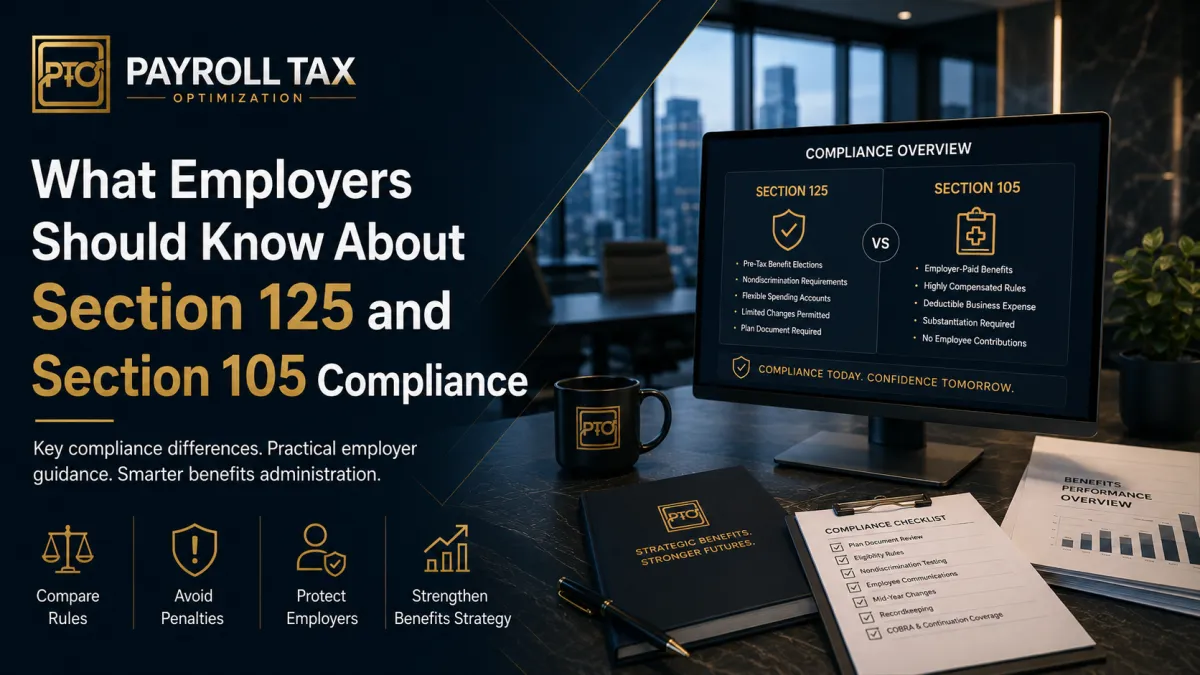
Section 125 of the Internal Revenue Code authorizes employers to offer cafeteria plans through which employees may elect qualified benefits on a pre-tax basis. To qualify under §125, the plan must meet four core requirements:
First, the plan must be a written plan document. A Section 125 plan cannot be informal or implied; it must exist as a formal written instrument that specifies eligible employees, qualified benefits offered, election procedures, and plan year. Without a written plan document, the pre-tax treatment of employee elections is not authorized, and the FICA exclusion under IRC §3121(a)(5)(G) does not apply.
Second, the plan must offer at least one qualified benefit. Under §125, qualified benefits include coverage under an accident or health plan, dependent care assistance, and certain other employer-sponsored benefits. A SIMERP established under §105 qualifies as an accident and health benefit, which is what connects the two code sections in a compliant program structure.
Third, the plan must allow employees to choose between taxable and non-taxable benefits. The cafeteria plan structure requires that employees actually have an election; the benefit cannot simply be imposed. Employee elections must be documented and maintained as plan records.
Fourth, the plan must comply with nondiscrimination testing requirements. Section 125 plans are subject to IRS nondiscrimination rules that prevent highly compensated employees from disproportionately benefiting. Employers should confirm that the program they are evaluating accounts for nondiscrimination testing as part of annual plan administration.
Section 105 — The Reimbursement Plan Requirements
Section 105 authorizes employer-funded self-insured medical expense reimbursement plans. For a §105 reimbursement plan to operate on a tax-free basis, it must meet the following requirements:
Reimbursements must be for qualified medical expenses as defined under IRC §213(d). This means the plan cannot reimburse arbitrary expenses; it must be tied to a defined and documented list of qualifying medical care costs. The TPA administering the plan is responsible for verifying that claims correspond to §213(d)-qualified expenses before processing reimbursements.
The plan must be employer-funded. Under §105, the employer, not the employee, funds the reimbursement benefit. This is the structural distinction that separates a §105 SIMERP from an FSA, which is employee-funded. The employer-funded nature of the plan is what creates the FICA exclusion when the §105 SIMERP is structured within a §125 cafeteria plan.
The plan must not discriminate in favor of highly compensated individuals. Like §125, Section 105 includes nondiscrimination requirements. Plans that disproportionately benefit owners, officers, or highly compensated employees may lose their tax-exempt status on reimbursements to those individuals. Compliant program administration includes an annual review of these requirements.
Formal plan documentation must be maintained. The plan must have a governing document, not just a summary, that specifies the benefit structure, eligible expenses, claims procedures, and administrative responsibilities. This documentation is the first thing an auditor will request if the plan is ever reviewed.
Missed Opportunity: Employers Who Never Validated Their Program's Compliance Infrastructure
Many employers who are currently enrolled in a Section 125 or SIMERP program have never performed a serious compliance review of the specific program they are in. They evaluated the savings projection, approved implementation, and assumed the compliance infrastructure was in place without independently verifying it.
That assumption is understandable, but it is a meaningful exposure. Here is what a properly built compliance infrastructure should include, and what employers should verify is in place:
Written plan document under §105 and §125: This is non-negotiable. If the program cannot produce a formal plan document on request, the pre-tax treatment is not defensible. Employers should request and review the plan document before implementation, not after.
Actuarial certification: A compliant §105 SIMERP requires actuarial support — documentation that the reimbursement structure is actuarially sound and that the qualified medical expenses being reimbursed are priced consistently with §213(d) requirements. Actuarial certification is one of the materials that TPA-supported programs should maintain on file and make available to enrolled employers.
ERISA alignment: The program must be administered within an ERISA-aware framework. This means the employer has a plan that qualifies as an ERISA-covered benefit plan, with summary plan descriptions, administrative records, and employee disclosures maintained according to ERISA requirements. ERISA compliance is reviewed and supported through formal plan materials, not improvised after an inquiry arrives.
ACA compliance: The program is structured to require that participating employees have qualifying health coverage in place. This preserves alignment with the ACA's Minimum Essential Coverage requirement and positions the plan within the participatory wellness model described in Federal Register Vol. 78, dated June 3, 2013. Employers should confirm that their specific program design requires qualifying coverage as a condition of participation.
HIPAA-aware data handling: Protected health information collected through plan administration — including claims data, employee health elections, and medical expense documentation — must be handled under HIPAA-aware processes. The TPA managing the program is responsible for this, but employers should verify that the TPA's data handling standards are documented and that the program operates under HIPAA-aware administrative controls.
SOC 2 Type II certified TPA: SOC 2 Type II certification is the operational security standard that employers and their advisors expect before trusting a program with payroll and health data. It covers data handling, access controls, audit logging, and operational security processes. Employers should confirm this certification is current before approving implementation. The program administered through Payroll Tax Optimization operates under SOC 2 Type II certified administration.
Employers who want to validate each of these elements for this specific program can review the full Section 125 compliance framework, which covers all of the above in detail alongside audit history, DOL review records, and ERISA legal opinion documentation.
Audit Protection: What Happens If the IRS or DOL Reviews the Plan
One of the most important compliance questions employers ask is: What happens if we get audited while enrolled in this program?
The answer depends entirely on how well the program has been built and maintained from day one. A program with complete documentation, actuarial certification, ERISA-aligned plan materials, and a SOC 2-certified TPA is in a fundamentally different position than one that assembled its compliance materials retroactively in response to an inquiry.
The program administered through Payroll Tax Optimization has passed multiple IRS and DOL audits with zero enforcement actions. Employers enrolled in the program receive audit protection support, meaning that if an IRS or DOL inquiry arrives, the TPA provides the required documentation package, including the plan document, actuarial certification, payroll records, and employee elections, to support the employer's response.
Employers are not expected to build the response from scratch or locate materials that were never properly maintained. The compliance infrastructure is maintained proactively and continuously, not assembled after the fact.
This is one of the most significant distinguishing factors between a compliance-first program and one that leads with savings projections without the documentation infrastructure to support them. The employer FAQ library on Section 125 and SIMERP covers the audit protection question in full, including what specific materials are maintained, how the TPA supports employer responses, and what the audit track record of the program looks like.
How the Compliance Framework Protects Employers Day to Day
Beyond audit scenarios, the compliance infrastructure of a Section 125 and Section 105 program affects how the plan operates every single day. Here is what that looks like in practice for enrolled employers:
Plan documents are maintained from day one: The governing plan document, employee election forms, and administrative procedures are established at implementation and kept current throughout the plan year. Employers do not need to maintain these materials internally; the TPA manages the full documentation lifecycle.
Employee elections are recorded and preserved: Every employee's pre-tax election is documented and stored as a plan record. These records are essential for two reasons: they establish the legal basis for the FICA exclusion under §3121(a)(5)(G), and they are the first materials an auditor will request if the plan is reviewed.
Claims are processed against §213(d) qualified expense classifications: The TPA verifies each reimbursement claim against the qualified medical expense definitions under §213(d) before processing payment. This ensures the tax-free treatment of reimbursements is defensible, not simply assumed.
Payroll integration is maintained accurately: The pre-tax election amounts are reflected correctly in payroll processing every cycle. The FICA reduction is applied at the source, not as a year-end adjustment, meaning the compliance and the savings are aligned from the first cycle forward.
Annual nondiscrimination testing is administered: The TPA manages nondiscrimination testing for both the §125 and §105 components of the plan, ensuring the program remains compliant with IRS requirements on an ongoing basis rather than only at implementation.
Employers in labor-intensive industries, such as automotive, manufacturing, healthcare, and education, where large W-2 workforces make the FICA savings most significant, also have the most complex day-to-day compliance requirements to maintain. Sector-specific context on how the program handles those requirements is available at how the program applies across industries.
Who Qualifies for a Compliant Section 125 and Section 105 Program
The compliance infrastructure described above is designed for employers who meet the following general profile — though final eligibility depends on a full workforce and payroll review:
100 or more W-2 employees: the general threshold at which the program economics are meaningful and the compliance infrastructure is cost-justified
Existing qualifying health coverage: employees must have compliant major medical coverage to participate, which preserves ACA alignment
Standard W-2 payroll structure: the §125 pre-tax election mechanics depend on W-2 payroll reporting and employer-sponsored plan participation
Leadership committed to a documented benefit structure: the program requires formal plan documents, TPA administration, and ERISA-aligned infrastructure from day one
Advisors who can validate the compliance framework: CFOs, legal counsel, and HR leaders who want to independently verify the legal foundation before approving implementation
Additional employer education on the compliance requirements, qualification criteria, and implementation process is available through the Section 125 employer guides and resources.
Key Compliance Benefits Employers Should Understand
For qualifying employers who implement a properly structured Section 125 and Section 105 program, the following compliance outcomes are built into the program design:
IRS code grounded structure: The program is built on §105, §125, and §213(d), established federal tax code sections, not novel or experimental positions. The pre-tax treatment is explicitly authorized under IRC §3121(a)(5)(G) and §3306(b)(5)(G).
Zero enforcement audit record: The TPA managing the program has passed multiple IRS and DOL audits with zero enforcement actions, a documented compliance record, not a claim.
Full documentation is maintained by the TPA: Plan documents, employee elections, actuarial certification, payroll records, and audit-response materials are maintained proactively throughout the life of the program.
ERISA, ACA, and HIPAA alignment built in: The program is structured with all three regulatory frameworks in place from day one, not retrofitted after compliance questions arise.
SOC 2 Type II certified administration: Data handling, claims processing, and operational security are administered under SOC 2 Type II certification standards.
Self-funding implementation: FICA savings generated by the program cover implementation costs, meaning there is no net upfront employer investment required to access a fully compliant structure.
Common Compliance Mistakes Employers Make
Approving implementation without reviewing the plan document: The plan document is the legal foundation of the program. Employers who approve implementation based on a summary presentation without reviewing the actual plan document are accepting compliance risk they may not be aware of.
Assuming compliance is the vendor's problem alone: Employers sponsor the benefit plan. Under ERISA and IRS rules, the employer has legal obligations as plan sponsor, including maintaining plan documents, providing employee disclosures, and filing required reports. A good TPA handles these on the employer's behalf, but the employer should understand what those obligations are and confirm they are being met.
Not verifying TPA credentials before implementation: SOC 2 Type II certification, HIPAA compliance, ERISA awareness, and documented audit history are verifiable. Employers should ask for them, not assume they exist because the program claims compliance.
Treating nondiscrimination testing as optional: Both §125 and §105 have nondiscrimination requirements. Plans that fail nondiscrimination testing may lose their tax-exempt status for highly compensated employees. Annual testing is a required element of ongoing compliance, not a one-time setup task.
Delaying review until a compliance question arises: Compliance review is most effective before implementation, not after a problem surfaces. Employers who invest in a thorough compliance evaluation upfront build a program they can defend; those who skip it build exposure they cannot.
Conclusion
Section 125 and Section 105 compliance is not a background detail in a payroll tax savings strategy; it is the structure that determines whether the savings are durable or exposed. Written plan documents, actuarial certification, ERISA alignment, ACA and HIPAA compliance, SOC 2 certified TPA administration, and a documented audit record are not optional features of a defensible program. They are the program.
For employers with 100 or more W-2 employees who want to capture meaningful FICA savings through a legally sound, fully documented benefit structure, the compliance infrastructure described in this guide is exactly what a compliant Section 125 and Section 105 program looks like from the inside. The savings and the compliance are not separate considerations; they are inseparable components of the same well-built plan.
The evaluation starts by understanding both dimensions, the savings potential and the compliance foundation, simultaneously. The live calculator models the first. The compliance page addresses the second.
Ready to Review a Fully Compliant Section 125 Strategy for Your Business?
Get your free savings estimate today. Use the live savings calculator at Payroll Tax Optimization to model your potential annual and monthly FICA reduction based on your W-2 headcount, then request your free savings report for a full breakdown of the compliance framework, employer fit, and implementation timeline: no upfront cost, no obligation, and no need to change your current health plan.