Can Employers Keep Their Current Health Plan and Still Qualify for Payroll Tax Savings?
Can employers keep their existing health insurance and qualify for payroll tax savings? Learn how Section 125 eligibility, benefits, and compliance work together.
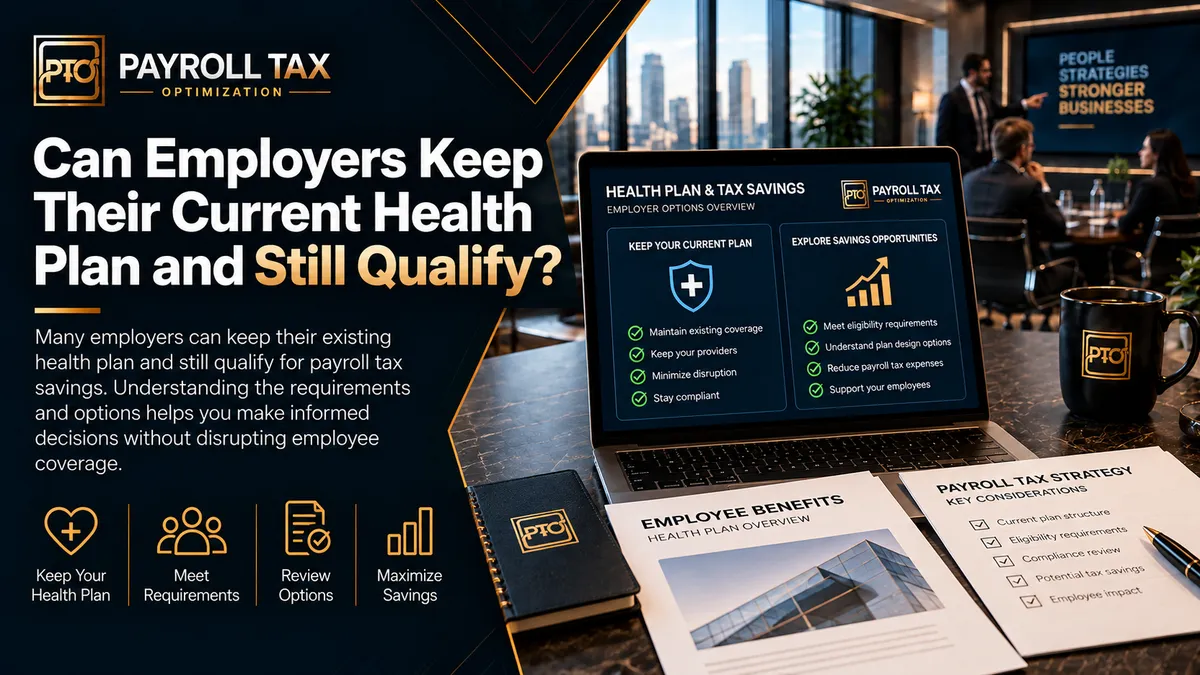
For employers that have spent years building a dependable health benefits package, the idea of changing insurance carriers just to reduce operating costs can be hard to justify. New networks, unfamiliar plan terms, and another enrollment process can create unnecessary disruption. That is why one of the first questions about payroll tax savings is whether businesses can keep their current health plan and still qualify.
For the Section 125 and Section 105 structure described by Payroll Tax Optimization, preserving major medical coverage is part of the intended design. The strategy is evaluated as an additional benefits arrangement, not a replacement policy. However, keeping your insurance and qualifying for favorable payroll-tax treatment are two different questions.
The Problem: Employers Assume Tax Savings Require Changing Health Plans
Finance leaders often regard employer FICA taxes as a fixed operating expense. Meanwhile, HR teams may hesitate to consider any new program that sounds like it could disrupt employees' existing coverage, insurance carriers, or broker relationships.
The confusion comes from mixing two separate decisions: who provides major medical insurance and how eligible additional benefits are structured through payroll. A qualified Section 125 cafeteria plan may allow employees to elect certain benefits on a pre-tax basis. This does not inherently require an employer to cancel its current health insurance.
The real challenge is determining whether a proposed arrangement fits the company's current benefits and satisfies applicable tax and employee-benefit rules. Keeping coverage intact is helpful, but it does not establish compliance by itself.
The Missed Opportunity: Payroll Tax Savings Within Existing Benefits
Some businesses dismiss payroll tax strategies without checking whether their current structure could support an additional eligible benefit. Employers with substantial W-2 workforces may be especially interested in reviewing that possibility.
When qualifying benefit elections receive valid pre-tax treatment, the compensation subject to employer FICA taxes may decrease. The savings come from the treatment of eligible benefits, not from canceling health insurance or simply labeling ordinary wages as reimbursements.
An effective review considers existing coverage, payroll data, workforce mix, participation, and administrative costs together. Employers can explore payroll tax savings across different industries to see why an automotive dealership, manufacturer, or healthcare employer might evaluate the opportunity differently.
How Payroll Tax Optimization Helps Preserve Existing Coverage
Payroll Tax Optimization describes a structure combining a Section 125 cafeteria plan with a Section 105 Self-Insured Medical Expense Reimbursement Plan (SIMERP). These provisions have different roles:
Pre-tax elections: Eligible employees make documented elections for qualifying benefits under the Section 125 plan.
Medical reimbursements: A Section 105 arrangement addresses reimbursement of eligible medical expenses according to plan terms and substantiation rules. Not every wellness payment is tax-free.
Payroll coordination: An administrator works with payroll teams to handle permitted deductions, reporting, and reconciliation.
Ongoing administration: Written plan documents, enrollment records, reimbursement evidence, and privacy safeguards support operation and oversight.
The main medical plan is intended to stay in place, along with existing carrier and broker relationships. Employees may receive supplemental benefits, depending on the exact program and their eligibility.
This is not automatic approval of a specific tax arrangement. Employers should have their tax and benefits advisors review its Section 125 compliance requirements, including relevant IRS guidance and ERISA, ACA, and HIPAA obligations.
Who Qualifies While Keeping Their Current Health Plan?
Having insurance already does not, by itself, establish eligibility. Payroll Tax Optimization identifies employers with approximately 100 or more W-2 employees as a common starting point for evaluating program economics. That is a practical screening guideline, not a universal legal minimum.
Important considerations include:
W-2 workforce: Employee status and headcount matter because the model focuses on employer payroll taxes. Independent contractors generally fall outside this framework.
Qualifying coverage: The program states that participating employees must maintain qualifying health coverage, which needs verification.
Workforce composition: Salaried, hourly, and eligible part-time workers may have different participation patterns.
Existing benefit arrangements: Current cafeteria plans, HSAs, and reimbursement benefits may require careful coordination.
Documented participation: Actual elections and enrollment influence whether the arrangement works and how savings are modeled.
For a closer look at the employer profile, read the employer qualification guide. No company should be assumed eligible based on headcount alone.
Key Benefits of Evaluating Eligibility Before Changing Coverage
Continuity for employees. Preserving major medical insurance can limit disruption to established networks and benefit relationships.
Potential employer FICA savings. Eligible pre-tax benefit elections may reduce applicable employer payroll taxes. Results depend on wages, participation, tax limits, and plan design.
More manageable implementation. Working alongside existing benefits and payroll systems may be less disruptive than changing carriers, although HR communication and administrative work are still necessary.
Clearer financial planning. Modeling net savings after fees, participation assumptions, and ongoing obligations gives CFOs a stronger basis for decisions than a headline estimate.
Common Mistakes Employers Should Avoid
Assuming current insurance guarantees qualification. Existing health coverage may be compatible, but eligibility still depends on the additional plan, employees, and administration.
Using total headcount for every estimate. Counting 1099 contractors or assuming universal participation can inflate projections. Only employees who actually meet plan requirements and participate should drive realistic estimates.
Treating every wellness payment as tax-free. IRS guidance distinguishes eligible medical expense reimbursements from certain cash payments that may be taxable wages. Carefully review reimbursement rules and substantiation requirements.
Skipping professional review. Tax advisors, benefits counsel, brokers, and payroll administrators should understand the design before implementation. Questions about employee eligibility, reporting, and recordkeeping are addressed in the site's employer eligibility FAQs.
Even a well-documented plan should be evaluated on its specific facts; no provider's marketing statement substitutes for that assessment.
Conclusion: Existing Health Insurance Is Not Necessarily a Barrier
Employers do not always have to choose between familiar health insurance and exploring payroll tax savings. An appropriately designed supplemental benefits strategy may work alongside existing coverage. Whether it qualifies, and how much it can save, depends on the plan structure and participating workforce.
Reviewing coverage, payroll data, administration, and legal requirements together creates a clearer basis for a confident decision.
Check Eligibility and Request Your Savings Estimate
Want to learn whether your business may qualify without replacing its current health plan? Explore Payroll Tax Optimization's Section 125 payroll tax savings strategy and use the site's calculator for an initial estimate. You can also request a consultation and individualized savings review to discuss workforce eligibility, program costs, and compliance documentation.
Keep the coverage your team relies on. Evaluate the savings your business may qualify for.
Disclaimer: This article is educational, not tax or legal advice. Eligibility and savings depend on the specific plan and applicable law. Consult qualified advisors before implementation.